
Chihiro UI
Chihiro is a lightweight web UI for creating and managing workload clusters. It gives users a form-based interface to provision clusters without writing YAML by hand. Chihiro lives on the management cluster and is accessible at chihiro.mgmt.rpcu.lan.
How it works
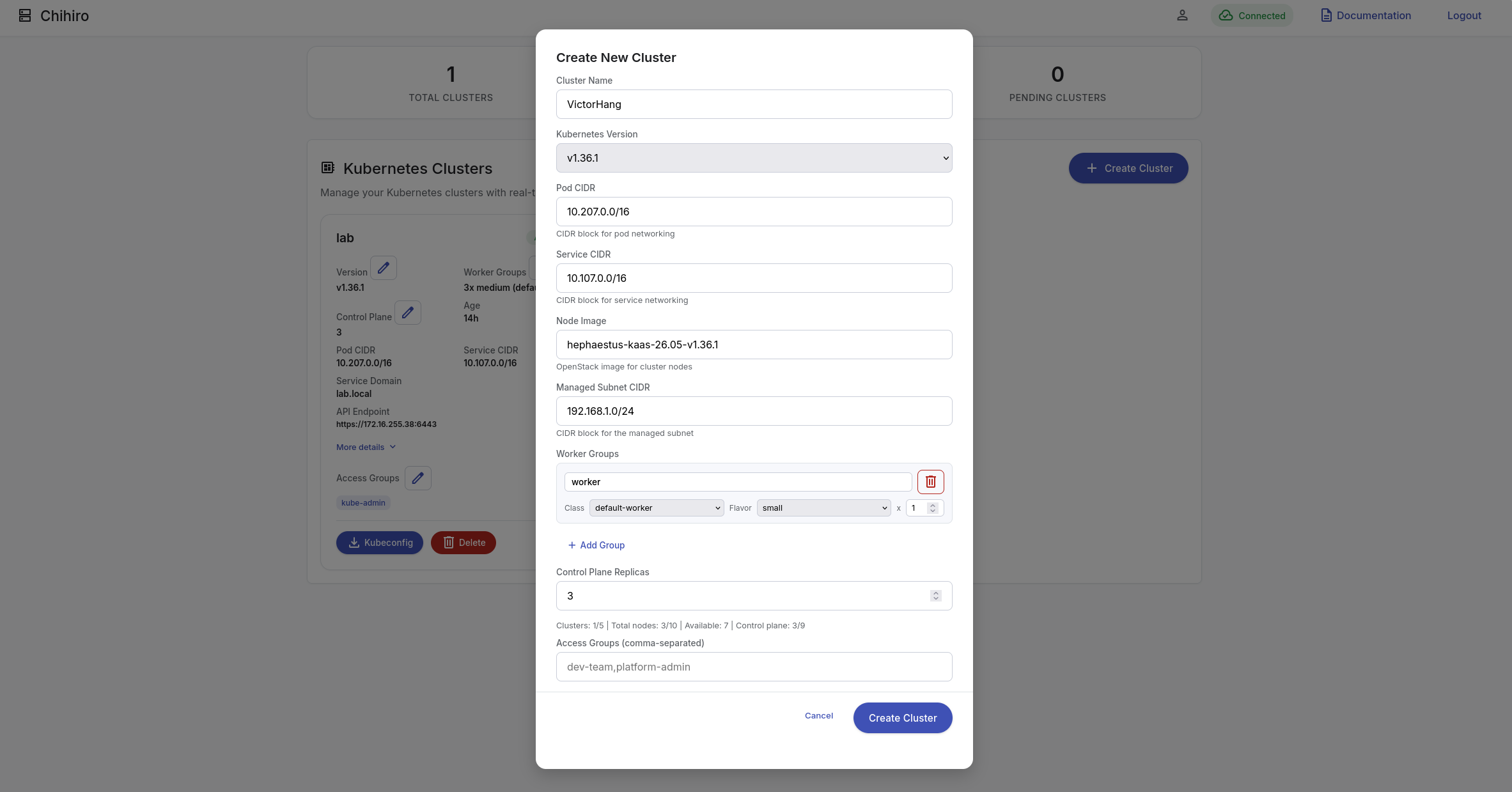
Chihiro reads a Cluster template (a Go-template for a CAPI Cluster CR) plus a set of injections, parameters, and worker-group fields from its config. The UI renders a form from these definitions, fills the template, and applies the resulting Cluster resource to the management cluster.
Configuration lives in two places:
| Surface | What it configures | Where |
|---|---|---|
config.yaml (mounted from the chihiro ConfigMap) | The cluster template and the entire form: injections, parameters, worker-group schema, version list, limits, RBAC groups | clusters/mgmt/apps/chihiro/cm.yaml |
| Environment variables (in the Deployment) | Runtime wiring: OIDC, Redis/sessions, host/port, secrets, and overrides for some config.yaml keys | clusters/mgmt/apps/chihiro/deploy.yaml |
Every config.yaml key under cluster: can be edited live — Chihiro re-reads the ConfigMap on its next sync and the form updates immediately, no code change or rebuild required. Environment variables (below) override the matching config.yaml key when set, which is how secrets and per-environment values are injected.
Configuring the form (config.yaml)
The whole form is driven by the cluster: block of config.yaml. The sections below cover each piece.
Cluster template
cluster.template is the CAPI Cluster manifest Chihiro renders for each new cluster. It is a Go-template: any {{ chihiro.<name> }} token is filled from the matching parameter or a built-in (see below). The worker machineDeployments array is generated separately from the worker-group form and injected into the topology.
cluster:
  template: |
    apiVersion: cluster.x-k8s.io/v1beta2
    kind: Cluster
    metadata:
      namespace: mgmt
    spec:
      clusterNetwork:
        pods:
          cidrBlocks:
            - {{'{{ chihiro.podCIDR }}'}}
        services:
          cidrBlocks:
            - {{'{{ chihiro.serviceCIDR }}'}}
      topology:
        classRef:
          name: openstack-kamaji
        version: "0.0.0"
Built-in tokens are always available in the template without declaring a parameter: {{ chihiro.name }}, version, groups, serviceDomain, and controlPlaneReplicas. These come from the core form fields.
Injections — core Cluster fields
Injections map a path inside the rendered Cluster spec to one of Chihiro's built-in form fields. They control the label shown in the UI and whether the value can be edited after the cluster exists.
cluster:
  injections:
    name:
      path: metadata.name
    version:
      path: spec.topology.version
      label: "Kubernetes Version"
      editable: true
    serviceDomain:
      path: spec.clusterNetwork.serviceDomain
    groups:
      label: "Access Groups"
      editable: true
    workerGroups:
      path: spec.topology.workers.machineDeployments
      label: "Worker Groups"
      editable: true
    controlPlaneReplicas:
      path: spec.topology.controlPlane.replicas
      label: "Control Plane Replicas"
      editable: true
      min: 1
max: 9| Key | Meaning |
|---|---|
path | Dot-path into the Cluster spec the value is written to/read from. |
label | Field label shown in the form (defaults to a humanised key). |
editable | true lets users change the value after creation. Defaults to false. |
min / max | Bounds for numeric fields (e.g. control-plane replicas). |
Paths support array indices and quoted segments for keys containing dots/slashes, e.g.
spec.topology.variables[2].valueormetadata.labels.'sveltos.argus.rpcu.io/cilium'.
Parameters — custom form fields
Parameters add form fields that are not core Cluster fields. Each one is exposed to the template as a {{ chihiro.<key> }} token. They support string, number, boolean, and select types.
cluster:
  parameters:
    podCIDR:
      label: "Pod CIDR"
      description: "CIDR block for pod networking"
      type: string
      default: "10.207.0.0/16"

    # A select whose options are constrained by another field (the version):
    imageName:
      label: "Node Image"
      description: "OpenStack image for cluster nodes"
      type: select
      options:
        - value: "hephaestus-kaas-25.11-{{'{{ chihiro.version }}'}}"
          label: "25.11"
          constrain:
            version: ["v1.35.4"]
        - value: "hephaestus-kaas-26.05-{{'{{ chihiro.version }}'}}"
          label: "26.05"
          constrain:
            version: ["v1.36.1"]
      default: "hephaestus-kaas-26.05-{{'{{ chihiro.version }}'}}"
      editable: true
      path: "spec.topology.variables[2].value"

    # A boolean that toggles a Sveltos label, admin-only:
    oidcRbac:
      label: "OIDC RBAC"
      description: "Enable OIDC RBAC addon via Sveltos"
      type: boolean
      default: true
      true_value: enabled
      false_value: disabled
      editable: true
      path: "metadata.labels.'sveltos.argus.rpcu.io/oidc-rbac'"
      visible_groups:
- kube-admin| Key | Applies to | Meaning |
|---|---|---|
label | all | Field label (defaults to a humanised key). |
description | all | Help text shown under the field. |
type | all | string (default), number, boolean, or select. |
default | all | Default value. May reference other parameters/built-ins via {{ chihiro.* }}. |
required | all | Marks the field required in the form. |
options | select | List of choices — plain strings, or { value, label, constrain } objects. |
constrain | select option | Maps another field → allowed values; the option is only offered when that field currently matches. |
true_value / false_value | boolean | Strings substituted into the template for on/off (default "true"/"false"). |
editable | all | true lets the value be edited after creation. Requires path. |
path | all | Dot-path where the value is written when edited post-creation. |
recompute_on | all | List of other fields whose change should re-resolve this parameter. Useful when a dependency can't be inferred from constrain metadata. |
implies | all | Declares fields this parameter pushes values to when edited. Each entry is {field, source} where source maps allowed values to the value written back. |
visible_groups | all | OIDC groups allowed to see/edit the field in the form. Empty = everyone. Admins always see all fields. |
When constrain metadata is enough to express a dependency between fields, Chihiro auto-detects it. For cases where the dependency cannot be inferred from the option constraints, use recompute_on to declare it explicitly. The implies field lets a parameter push values to other fields when edited. See the README for full examples of both.
Worker-group fields
Worker groups are heterogeneous: each cluster can have multiple machine-deployment pools, and the inputs for each pool are defined by cluster.worker_group_fields. The cluster.worker_group_template then maps those inputs into a machineDeployment entry using {{ chihiro.field.<key> }} tokens.
cluster:
  worker_group_fields:
    name:
      label: "Group name"
      type: string
      required: true
      order: 0
    flavor:
      label: "Flavor"
      type: select
      options: [small, medium, xmedium, large, xlarge]
      default: xmedium
      order: 2
    replicas:
      label: "Replicas"
      type: number
      default: "1"
      min: 1
      max: 10
      order: 3

  worker_group_template: |
    name: {{'{{ chihiro.field.name }}'}}
    class: {{'{{ chihiro.field.class }}'}}
    replicas: {{'{{ chihiro.field.replicas }}'}}
    variables:
      overrides:
        - name: workerFlavor
          value: {{'{{ chihiro.field.flavor }}'}}
Each field supports label, type (string | number | select), options, default, required, min/max, order (display order), and visible_groups. Allowed worker flavors are configured here as the flavor field's options — not via an environment variable.
If
worker_group_fields/worker_group_templateare omitted, Chihiro falls back to a built-inname + class + flavor + replicasschema so it works out of the box.
Versions, limits, and RBAC groups
The remaining cluster: keys gate what users can pick and do:
cluster:
  domain: "mgmt.rpcu.lan" # control-plane endpoint domain
  port: 443
  available_versions: # versions users can choose / upgrade to
    - "v1.36.1"
    - "v1.35.4"
  admin_groups: [kube-admin] # full admin access
  creator_groups: [kube-admin] # allowed to create clusters
  limits:
    max_clusters: 5 # across all Chihiro-managed clusters
    max_total_nodes: 10
    max_total_cp: 9
The allowed_origins key (also settable via CHIHIRO_ALLOWED_ORIGINS) is a comma-separated list of full origin URLs trusted for OAuth redirect host detection and WebSocket origin checks. The OIDC redirect_url host is always implicitly trusted. Entries are validated by exact string match (no substring or wildcard matching).
Adding a new field — example
Adding a form field is a two-step edit to clusters/mgmt/apps/chihiro/cm.yaml:
1. Declare a parameter:
cluster:
  parameters:
    newField:
      label: "New Field"
      description: "What this field controls"
      type: string
      default: "some-default"
2. Reference it in the template:
cluster:
  template: |
    ...
    spec:
      someNewField: {{'{{ chihiro.newField }}'}}
Chihiro picks up the ConfigMap change on its next sync and renders the new field immediately.
Previewing the rendered YAML
The create form has a Preview YAML button that renders the exact Cluster manifest that will be applied — with all parameters resolved and the IP range allocated — without creating anything. Use it to sanity-check a template or parameter change before committing to the cluster. The preview enforces the same permissions as creation, so it can't be used to bypass creator_groups or assign groups you don't belong to.
Access
- URL:
chihiro.mgmt.rpcu.lan - Authentication: OIDC via the shared Zitadel instance (Authorization Code + PKCE)
- Authorization:
cluster.admin_groups(e.g.kube-admin) → admin;cluster.creator_groups→ may create clusters; everyone else → read-only
The OIDC application is managed by Crossplane (clusters/mgmt/crossplane/zitadel/oidc-chihiro.yaml). Client credentials are plumbed into the Deployment via External Secrets.
Runtime configuration (environment variables)
Environment variables in the Deployment wire up secrets and runtime dependencies. Where an env var maps to a config.yaml key, the env var wins when set — this is how per-environment values and secrets are injected without editing the ConfigMap.
Required
| Variable | Purpose |
|---|---|
CHIHIRO_OIDC_ISSUER_URL | OIDC issuer (Zitadel) URL |
CHIHIRO_OIDC_CLIENT_ID | OIDC client ID |
CHIHIRO_OIDC_CLIENT_SECRET | OIDC client secret (from External Secrets — never in config) |
CHIHIRO_SESSION_KEY | Session signing key, e.g. openssl rand -base64 32 |
Cluster form / RBAC overrides
| Variable | Overrides config.yaml key | Example |
|---|---|---|
CHIHIRO_CLUSTER_DOMAIN | cluster.domain | mgmt.rpcu.lan |
CHIHIRO_CLUSTER_PORT | cluster.port | 443 |
CHIHIRO_ADMIN_GROUPS | cluster.admin_groups | kube-admin |
CHIHIRO_CREATOR_GROUPS | cluster.creator_groups | kube-admin |
CHIHIRO_AVAILABLE_VERSIONS | cluster.available_versions | v1.36.1,v1.35.4 |
CHIHIRO_MAX_CLUSTERS | cluster.limits.max_clusters | 5 |
CHIHIRO_MAX_TOTAL_NODES | cluster.limits.max_total_nodes | 10 |
CHIHIRO_MAX_TOTAL_CP | cluster.limits.max_total_cp | 9 |
Comma-separated values (groups, versions) are split into lists.
Server, Redis, and sessions
| Variable | Overrides | Default |
|---|---|---|
CHIHIRO_HOST | host | 0.0.0.0 |
CHIHIRO_PORT | port | 8080 |
CHIHIRO_REDIS_ADDR | redis.addr | localhost:6379 |
CHIHIRO_REDIS_USERNAME | redis.username | "" |
CHIHIRO_REDIS_PASSWORD | redis.password | "" (use a secret) |
CHIHIRO_SESSION_TTL | redis.session_ttl | 3600 |
CHIHIRO_SESSION_SECURE | session.secure | auto (on for HTTPS redirect URLs) |
CHIHIRO_ALLOWED_ORIGINS | allowed_origins | — |
CHIHIRO_DOCS_URL | docs_url | — |
CHIHIRO_DEBUG | enables debug logging | off |
Source
Chihiro is deployed from Argus (clusters/mgmt/apps/chihiro/). It depends on cert-manager, kgateway, Dragonfly (Redis), External Secrets, and the Crossplane Zitadel resources.